🌅 Living Life at the Fullest: The Science, Philosophy & Psychology of a Meaningful Life
🌅 Living Life at the Fullest: The Science, Philosophy & Psychology of a Meaningful Life
“The purpose of life is not to be happy. It is to be useful, to be honorable, to be compassionate, to have it make some difference that you have lived and lived well.” — Ralph Waldo Emerson
We spend enormous amounts of time preparing to live.
We study so we can get a good career.
We work so we can earn money.
We earn so we can buy comfort.
We buy comfort so we can eventually have time.
And then, somewhere along the way, we realize something profound:
Life was happening while we were preparing for it.
Living life to the fullest doesn’t mean travelling constantly, becoming rich, partying every night, or eliminating every uncomfortable emotion.
It means being fully alive while you are alive.
It means waking up with purpose, experiencing ordinary moments deeply, building meaningful relationships, taking calculated risks, learning continuously, protecting your health, creating something valuable, helping others — and being present enough to actually experience the journey.

The goal isn’t to squeeze more activities into every minute.
The goal is to put more life into every minute. ❤️
🧠 1. The First Principle: Life Is Finite
One of the most powerful psychological ideas is also one of the simplest:
Your time is limited.
The human brain often behaves as though tomorrow is guaranteed. This creates what psychologists call temporal discounting — we tend to value immediate rewards more strongly than future consequences.
That’s why:
- We choose scrolling instead of exercising.
- We choose procrastination instead of meaningful work.
- We choose comfort instead of growth.
- We choose temporary pleasure over long-term fulfillment.
But remembering mortality can actually make life more meaningful.
Philosophers have explored this for centuries.
The Stoics called it Memento Mori:
“Remember that you will die.”
This isn’t meant to be depressing.
It is a reminder:
You don’t have unlimited time. Use today’s portion wisely.
Try this question:
“If I knew I had only five years left, what would I stop postponing?”
Your answer reveals your priorities.
🌱 2. The Difference Between Pleasure, Happiness & Meaning
One of the biggest mistakes people make is treating happiness as the ultimate goal.
There are actually different layers of a fulfilling life.
😋 Pleasure
Good food.
Entertainment.
Travel.
Comfort.
Money.
Relaxation.
Pleasure is valuable — but temporary.
😊 Happiness
Positive emotions, satisfaction, gratitude, connection and enjoyment.
🎯 Meaning
A sense that your life matters beyond immediate pleasure.
Psychologist Viktor Frankl argued that humans can endure extraordinary difficulties when they have a reason to live.
His philosophy can be summarized through his famous idea:
“He who has a why to live can bear almost any how.”
The happiest life isn’t necessarily the easiest life.
It is often the life where your struggles have meaning.
🧭 3. Find Your “Why”
A meaningful life usually requires something bigger than immediate gratification.
Ask yourself:
What do I want to experience?
Travel.
Love.
Adventure.
Learning.
Family.
Nature.
Creativity.
What do I want to create?
A business.
A family.
A product.
Art.
Knowledge.
A community.
A legacy.
What do I want to contribute?
Helping people.
Teaching.
Protecting nature.
Building useful technology.
Supporting your community.
Your why doesn’t need to be world-changing.
It can simply be:
“I want to become the best version of myself and make the lives of the people around me better.”
That’s enough.
🧠 4. Self-Determination Theory: The Psychology of a Fulfilling Life
Psychologists Edward Deci and Richard Ryan developed Self-Determination Theory, which identifies three fundamental psychological needs:
1️⃣ Autonomy
The feeling that you’re directing your own life.
You need:
“I choose.”
Not:
“I have no choice.”
2️⃣ Competence
The feeling that you’re becoming capable.
Learning programming.
Getting stronger.
Becoming better at communication.
Mastering a craft.
Progress creates satisfaction.
3️⃣ Relatedness
The feeling that you belong and matter to others.
Family.
Friends.
Community.
Love.
When these three needs are supported, people tend to experience greater motivation and well-being.
So ask yourself every week:
Am I choosing my life, improving myself, and connecting with people I care about?
🔥 5. The Growth Mindset
Psychologist Carol Dweck popularized the concept of growth mindset.
A fixed mindset says:
“I’m not good at this.”
A growth mindset says:
“I’m not good at this yet.”
That tiny word — yet — changes everything.
Failure becomes information.
Rejection becomes feedback.
Difficulty becomes training.
Mistakes become teachers.
Instead of asking:
❌ “Why am I failing?”
Ask:
✅ “What is this failure teaching me?”
⚡ 6. Flow: When You Forget Time Exists
Psychologist Mihaly Csikszentmihalyi described flow as a state of deep absorption where you’re completely immersed in an activity.
You lose awareness of time.
It happens when:
- The challenge is meaningful.
- Your skill level is sufficient but stretched.
- Feedback is immediate.
- Distractions are minimized.
- Your attention is completely engaged.
You may experience flow while:
🎨 Painting
💻 Coding
🏀 Playing basketball
🎸 Playing music
📚 Studying
🏃 Running
✍️ Writing
🌱 Gardening
A full life isn’t necessarily one where you do more.
It’s one where you experience more deeply.
📱 7. Protect Your Attention
Your attention is one of your most valuable assets.
Modern technology competes aggressively for it.
Notifications.
Short videos.
Infinite scrolling.
Algorithms.
Constant messages.
Every distraction has an opportunity cost.
If you spend two hours mindlessly scrolling every day, that’s roughly:
730 hours/year.
That’s more than 30 full days.
Imagine investing those hours into:
📚 Reading
🏋️ Fitness
💻 Building something
❤️ Family
🌳 Nature
🎯 Your goals
The question isn’t:
“Do I have enough time?”
The better question is:
“Where is my attention going?”
🧘 8. Mindfulness: Actually Being Where You Are
A strange tragedy of modern life is that the body can be somewhere while the mind is somewhere else.
Eating while watching your phone.
Talking while thinking about work.
Walking while scrolling.
Travelling while worrying about tomorrow.
Mindfulness means deliberately returning attention to the present.
Try this:
When you’re eating:
Just eat.
When you’re talking:
Just listen.
When you’re walking:
Notice the surroundings.
When you’re with family:
Be there.
A five-minute ordinary moment experienced completely can be more valuable than an hour experienced distractedly.
❤️ 9. Relationships Are Not Optional
One of the strongest findings from long-running well-being research is that high-quality relationships are deeply associated with health and life satisfaction.
Human beings evolved to live socially.
Success without connection can become loneliness.
Money without relationships can become emptiness.
Achievement without someone to share it with can feel surprisingly hollow.
Invest in people.
Call your parents.
Have dinner without phones.
Meet old friends.
Tell someone you love them.
Forgive when appropriate.
Apologize when necessary.
Listen without immediately trying to solve everything.
Because one day, many of the things you worked so hard to obtain may matter less than who was beside you while you were obtaining them.
🌿 10. Practice Gratitude Without Becoming Complacent
Gratitude doesn’t mean:
“Everything is perfect.”
It means:
“Even though everything isn’t perfect, there are things worth appreciating.”
You can simultaneously want more from life and appreciate what you already have.
Every night, write three things:
- Something you’re grateful for.
- Something you learned.
- Something you’re looking forward to.
This trains your attention toward positive aspects of your experience.
🏃 11. Your Body Is the Foundation
You cannot consistently live an extraordinary life while treating your body like an afterthought.
The basics remain extraordinarily powerful:
😴 Sleep
Adequate sleep supports cognitive performance, emotional regulation, recovery and overall health.
🏋️ Exercise
Resistance training, cardiovascular activity, walking and sports all contribute to physical and psychological well-being.
🥗 Nutrition
Prioritize nutritious whole foods, adequate protein, vegetables, fruits, healthy fats and sufficient hydration.
☀️ Sunlight & Nature
Spend time outdoors.
Walk.
See the sky.
Touch grass — literally. 🌳
🧘 Recovery
Rest isn’t laziness.
Recovery is part of performance.
🎯 12. The Principle of Deliberate Practice
If you want to become exceptional at something, simply repeating the activity isn’t enough.
Deliberate practice involves:
Challenge → Feedback → Correction → Repetition
For example, a programmer doesn’t become excellent by writing the same simple code for ten years.
Instead:
Learn a difficult concept.
Build something.
Get feedback.
Study mistakes.
Refactor.
Solve harder problems.
Repeat.
This principle applies to almost everything:
🏀 Sports
💻 Programming
🎤 Communication
🎨 Art
📚 Learning
💼 Leadership
Don’t just accumulate years. Accumulate improvement.
🚪 13. Say Yes to Experiences
Research on experiential well-being suggests that experiences can create lasting memories and meaning in ways that many material purchases don’t.
So:
🌄 Watch a sunrise.
🏕️ Sleep under the stars.
🚗 Take an unplanned road trip.
🌊 Swim in the ocean.
📚 Read a book that changes your perspective.
🎵 Attend a concert.
👨👩👧 Spend time with family.
❤️ Tell someone how you feel.
Try something you’ve never done.
Your future memories are being created right now.
🦁 14. But Don’t Confuse Living Fully With Recklessness
Living fully doesn’t mean:
❌ Destroying your health
❌ Spending money irresponsibly
❌ Taking unnecessary risks
❌ Chasing every temptation
❌ Ignoring responsibilities
True freedom requires self-control.
The Stoics understood this beautifully.
You cannot control everything that happens to you.
But you can influence:
Your response.
That distinction is one of the foundations of emotional resilience.
🧘 15. The Stoic Circle of Control
Divide life into two categories.
Within your control:
Your actions.
Your effort.
Your habits.
Your attitude.
Your preparation.
Your response.
Outside your control:
Other people’s opinions.
The past.
The weather.
Unexpected events.
Other people’s decisions.
The economy.
Random luck.
Worrying about the second category consumes energy without necessarily producing results.
Focus on the first.
Ask:
“What can I do about this today?”
Then do that.
🌊 16. Acceptance Is Not Giving Up
Acceptance means acknowledging reality before deciding what to do next.
If it rains:
Accept the rain.
Then carry an umbrella.
If you fail:
Accept the failure.
Then learn.
If someone rejects you:
Accept the rejection.
Then continue.
If plans change:
Accept the change.
Then adapt.
The strongest people aren’t those who control everything.
They’re those who can adapt when they can’t.
🔥 17. The Antifragile Mindset
Some things don’t merely survive stress — they become stronger because of appropriate stress.
Muscles grow through resistance.
Skills grow through challenges.
Confidence grows through surviving difficult experiences.
Resilience grows when you discover:
“I went through something difficult — and I’m still here.”
Don’t deliberately seek suffering.
But don’t run from every difficulty either.
Sometimes the mountain is exactly what builds the person capable of reaching the summit.
🧠 18. Emotional Intelligence: Feel Everything, Obey Nothing Blindly
Emotions are information, not commands.
Anger may tell you that a boundary was crossed.
Fear may tell you that something matters.
Sadness may tell you that you’ve lost something meaningful.
Anxiety may signal uncertainty.
But feeling something doesn’t mean you must immediately act on it.
Use the sequence:
Notice → Name → Understand → Choose
Instead of:
Feel → React
That small gap between emotion and action can transform your life.
🕯️ 19. Learn to Be Alone
Being alone and being lonely are not the same thing.
Solitude can provide space for:
- Reflection
- Creativity
- Self-awareness
- Planning
- Reading
- Meditation
- Emotional processing
Spend some time without entertainment.
No phone.
No music.
No notifications.
Just you and your thoughts.
You may discover that the person you spend the least time getting to know is yourself.
🌌 20. Develop a Relationship With Wonder
One of the most underrated components of a full life is awe.
Look at:
🌌 The night sky
🌅 A sunrise
🌧️ Rain
🏔️ Mountains
🌊 Oceans
🌳 Ancient trees
👶 A newborn child
❤️ Human kindness
Awe makes us feel smaller — but strangely more connected.
It reminds us:
You are part of something much larger than your daily problems.
💰 21. Use Money as a Tool, Not an Identity
Money matters.
Financial stability reduces many forms of stress and creates freedom.
But after basic security and reasonable comfort, constantly increasing consumption isn’t guaranteed to produce proportional increases in happiness.
Use money to buy:
Freedom.
Experiences.
Education.
Health.
Time.
Opportunities to help others.
The goal shouldn’t be:
“How much can I accumulate?”
A better question is:
“What kind of life can my resources help me create?”
📖 22. Read Across Different Worlds
A powerful life requires multiple perspectives.
Read:
📚 Philosophy
🧠 Psychology
🔬 Science
💼 Business
🌎 History
❤️ Biography
🎨 Art
🧘 Spirituality
Books allow you to experience hundreds of lives without living all of them.
As Marcus Aurelius wrote:
“The happiness of your life depends upon the quality of your thoughts.”
Feed your mind accordingly.
🧭 23. Create a Personal Philosophy
Don’t blindly inherit your definition of success.
Design it.
Write your own principles.
For example:
My Life Principles
1. Health before wealth.
2. People before possessions.
3. Progress over perfection.
4. Experiences over unnecessary consumption.
5. Courage over comfort.
6. Curiosity over certainty.
7. Contribution over ego.
8. Presence over distraction.
9. Discipline over temporary motivation.
10. Meaning over meaningless achievement.
Your philosophy becomes your compass when life becomes confusing.
⏳ 24. Use the “Future Self” Test
Before making an important decision, ask:
“Will my future self thank me for this?”
Before skipping your workout:
“Will future me appreciate this?”
Before spending money:
“Will future me be happy with this?”
Before insulting someone:
“Will future me regret this?”
Before learning something difficult:
“Will future me be grateful I started?”
Your future self is built by the decisions of your present self.
🌱 25. Build Systems Instead of Depending on Motivation
Motivation fluctuates.
Systems remain.
Instead of:
“I’ll exercise when I feel motivated.”
Create:
“I exercise at 7 AM.”
Instead of:
“I’ll read more.”
Create:
“I read 20 pages before sleeping.”
Instead of:
“I’ll use my phone less.”
Create:
“No social media during the first hour after waking.”
Your environment often beats your willpower.
Make good behavior easy.
Make bad behavior inconvenient.
☀️ The Ultimate Daily Routine for a Fuller Life
There is no universally perfect routine.
But here’s a practical framework combining health, psychology, productivity, relationships and meaning.
🌅 6:00–6:30 AM — Wake Up
Don’t immediately reach for your phone.
Drink water.
Open the window.
Get some natural light.
Take a few deep breaths.
Ask:
“What would make today meaningful?”
🧘 6:30–6:45 AM — Mindfulness
Meditate.
Pray.
Journal.
Or simply sit quietly.
Write:
Today I am grateful for:
1.
2.
3.
Today’s most important action:
→ ______
🏋️ 7:00–8:00 AM — Move Your Body
Strength training.
Running.
Walking.
Yoga.
Cycling.
Sports.
The goal isn’t aesthetics alone.
You’re building the physical foundation for everything else.
🥗 8:00–9:00 AM — Nourish Yourself
Eat a nutritious breakfast.
Avoid beginning the day with endless notifications.
Give your brain a clean start.
💻 9:00 AM–12:00 PM — Deep Work
This is your creation window.
Work on the thing that matters most.
Use:
50 minutes focus → 10 minutes break
or another sustainable deep-work structure.
Keep distractions away.
Ask:
“If I accomplish only one important thing today, what should it be?”
Do that first.
🍲 12:00–1:00 PM — Eat & Reset
Have lunch.
Walk for a few minutes if practical.
Avoid turning your entire break into a social-media session.
🚀 1:00–4:00 PM — Build Your Future
Use this period for:
Learning.
Projects.
Meetings.
Creative work.
Career development.
Skill building.
Think:
“What am I doing today that makes tomorrow better?”
🌳 4:00–5:00 PM — Transition
Step away from work.
Walk.
Have tea.
Talk to someone.
Read.
Listen to music.
Let your brain transition from achievement mode to life mode.
🏀 5:00–6:30 PM — Play
This part is important.
Don’t make your entire life about productivity.
Play basketball.
Go cycling.
Play with children.
Walk with friends.
Explore somewhere.
Laugh.
Play is not wasted time.
It’s part of being human.
❤️ 6:30–8:00 PM — Relationships
Have dinner with family.
Talk.
Listen.
Ask someone:
“How was your day?”
Put the phone away.
A meaningful conversation can sometimes be more valuable than another hour of productivity.
📚 8:00–9:00 PM — Learn & Reflect
Read.
Study.
Write.
Build a skill.
Then ask:
What did I learn today?
What did I do well?
Where could I improve?
Did I behave according to my values?
Did I make someone’s life better?
🌙 9:00–10:00 PM — Slow Down
Reduce stimulating content.
Dim the environment.
Prepare for tomorrow.
Spend a few minutes reflecting.
Write:
3 things I’m grateful for.
1 lesson from today.
1 thing I’ll improve tomorrow.
😴 10:00–10:30 PM — Sleep
Sleep isn’t the enemy of productivity.
It is one of its foundations.
Protect your sleep.
Tomorrow needs the best version of you — not the exhausted version.
⚡ The “Full Life” Rule
Try to experience these 10 dimensions every day:
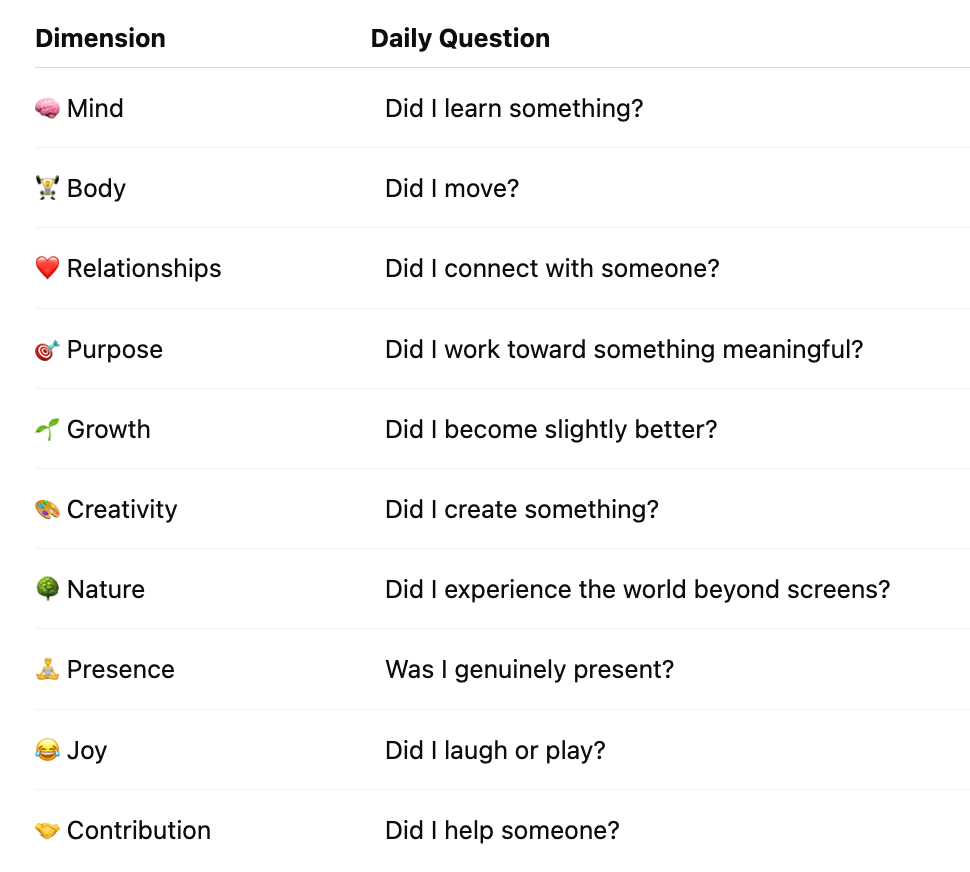
You don’t need a perfect score.
You need balance over time.
🧨 The 5-Minute Rule for Difficult Days
Some days will be terrible.
You won’t feel motivated.
You’ll be tired.
Something will go wrong.
On those days, don’t abandon the entire system.
Do the smallest version.
Can’t exercise?
Walk for 5 minutes.
Can’t study?
Read one page.
Can’t work on your dream?
Work for 5 minutes.
Can’t meditate?
Take ten conscious breaths.
Can’t solve the problem?
Write down the next step.
The objective isn’t perfection.
It’s maintaining the identity:
“I am someone who keeps moving.”
🌄 The Weekend Rule: Live, Don’t Just Recover
Don’t spend every weekend recovering from a life you dislike.
Create something worth recovering from and returning to.
Every week, try to include:
🌄 One adventure
📚 One learning experience
❤️ One meaningful conversation
🏃 One physical challenge
🎨 One creative activity
🌳 One nature experience
🤝 One act of kindness
🧘 Some intentional solitude
🧭 The Ultimate Life Audit
Once every month, ask yourself:
Health
Am I taking care of my body?
Relationships
Am I investing in people who matter?
Career
Am I becoming better at something valuable?
Money
Am I using money intelligently?
Learning
Am I still curious?
Adventure
When was the last time I did something new?
Contribution
Who benefited because I existed?
Presence
How often am I actually present?
Joy
Am I enjoying my life — or only preparing for it?
Meaning
If nothing changed for the next five years, would I be satisfied?
That final question can be uncomfortable.
It can also be transformative.
🌟 The Greatest Potential Isn’t About Becoming Someone Else
Your greatest potential isn’t necessarily becoming the richest person.
Or the most famous.
Or the most powerful.
It might simply mean becoming:
The healthiest version of you.
The wisest version of you.
The strongest version of you.
The kindest version of you.
The bravest version of you.
The most curious version of you.
The version of you that doesn’t constantly wonder, “What if?”
🕊️ Remember: A Full Life Contains Everything
A full life isn’t permanently happy.
It contains:
❤️ Love
😂 Laughter
😭 Tears
🔥 Ambition
😔 Failure
🌱 Growth
🌅 Beauty
💔 Loss
🎯 Purpose
🧘 Peace
🌪️ Chaos
🤝 Connection
🌌 Wonder
Don’t demand that life always feel good.
Demand that it mean something.
🌅 The Final Philosophy
One day, you will look back.
You probably won’t remember every email.
Every notification.
Every spreadsheet.
Every social-media argument.
Every ordinary Tuesday at work.
You’ll remember:
The people.
The places.
The adventures.
The conversations.
The risks you took.
The dreams you pursued.
The mornings you watched the sunrise.
The nights you laughed until your stomach hurt.
The times you helped someone.
The moments when you chose courage.
The times you were completely present.
So don’t wait for:
The perfect job.
The perfect body.
The perfect bank balance.
The perfect relationship.
The perfect house.
The perfect moment.
Because perfection is always moving.
Life isn’t waiting for you to become ready.
Life is happening now.
So work hard — but don’t forget to live.
Save money — but spend some of it creating memories.
Build your career — but don’t sacrifice every relationship for it.
Improve yourself — but don’t hate who you are today.
Plan for tomorrow — but don’t abandon today.
Dream big — but notice the small things.
Take responsibility — but leave room for spontaneity.
Seek success — but define success yourself.
And most importantly:
Don’t merely count the years in your life. Make the years count.
🌅 Wake up.
🧠 Learn.
🏋️ Move.
❤️ Love.
🎯 Create.
🌱 Grow.
🤝 Contribute.
😂 Play.
🌌 Wonder.
🧘 Be present.
And when the day ends, be able to say:
“I was here. I experienced it. I gave it my best. And today was worth living.”


Comments
Post a Comment