🚀 Ruby on Rails Hidden Methods: The Secret Toolkit for Writing Faster, Cleaner & Smarter Rails Code
🚀 Ruby on Rails Hidden Methods: The Secret Toolkit for Writing Faster, Cleaner & Smarter Rails Code
Ruby on Rails is famous for making complex things feel simple.
But that simplicity can hide an enormous amount of power.
Most Rails developers know find, where, render, redirect_to, and validates. Yet Rails contains hundreds of lesser-known methods that can dramatically improve performance, readability, database efficiency, API design, and maintainability.
The real Rails skill isn’t knowing more syntax.
It’s knowing which Rails abstraction solves a problem before writing unnecessary code yourself.
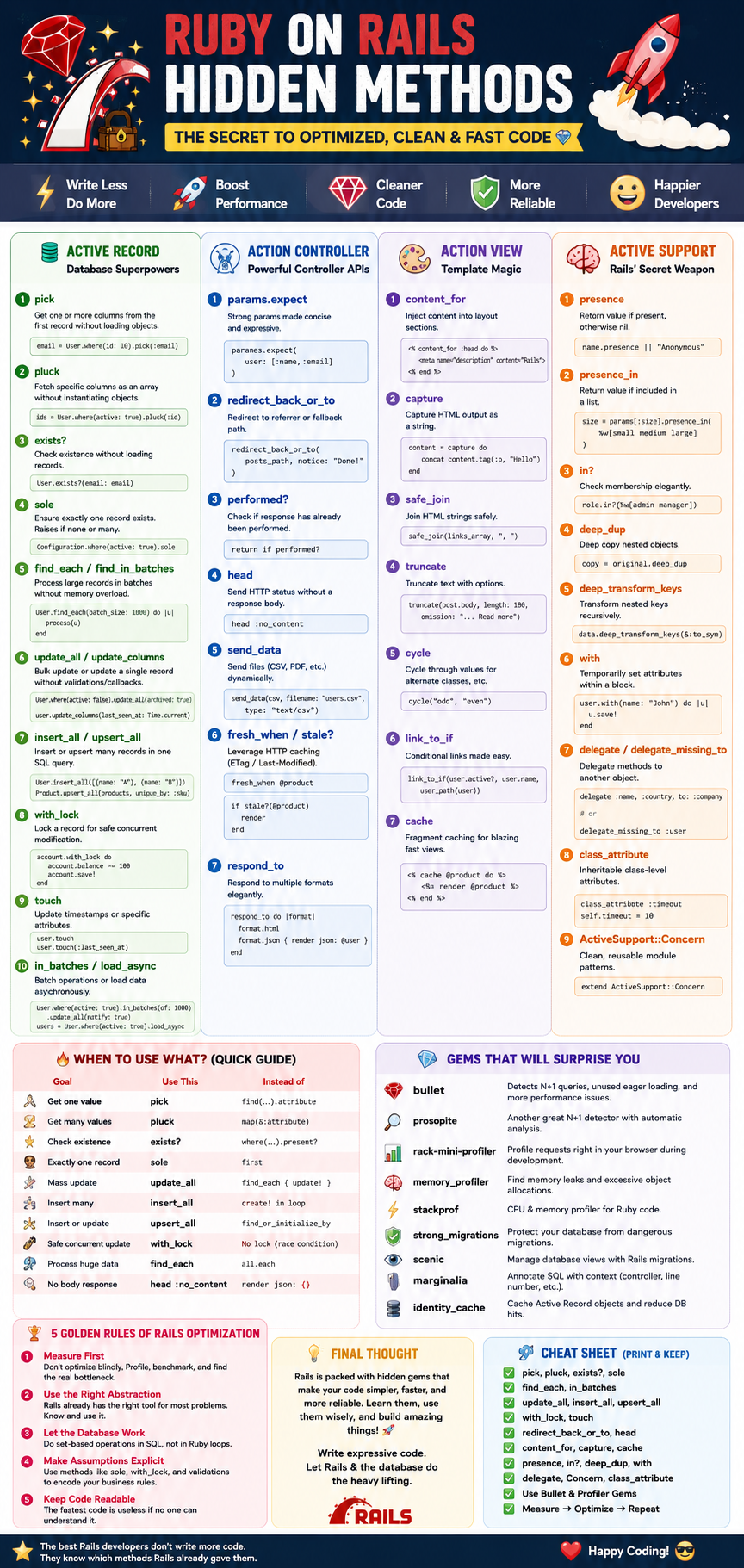
This guide dives deep into some of the most useful “hidden” methods across:
- 🗄️ Active Record
- 🎮 Action Controller
- 🎨 Action View
- 🧠 Active Support
- 💎 Powerful gems that add even more surprising capabilities
Note: Exact APIs can vary slightly between Rails versions. Examples below target modern Rails, with special attention to Rails 7/8-style APIs.
🗺️ 1. Active Record — Hidden Database Superpowers
Active Record is much more than an ORM that converts rows into Ruby objects.
It can help you control:
- SQL generation
- memory usage
- database round trips
- bulk operations
- locking
- eager loading
- asynchronous queries
- updates without callbacks
- batch processing
Let’s explore the methods that often go unnoticed.
🔍 2. pick — Get One Value Without Building an Object
Suppose you only need a user’s email.
A common approach is:
user = User.find(10)
user.email
But Rails creates a full User object.
Instead:
email = User.where(id: 10).pick(:email)The database essentially performs:
SELECT email FROM users WHERE id = 10 LIMIT 1;You get:
"user@example.com"Why is this useful?
Because you’re telling Rails:
“I don’t need an Active Record object. Give me the value.”
You can even retrieve multiple columns:
name, email = User.where(id: 10).pick(:name, :email)💡 Optimization principle
If you only need one scalar value, prefer:
pickover:
find(...).attribute📦 3. pluck — Skip Object Instantiation
Need thousands of IDs?
Don’t do:
User.all.map(&:id)That loads Active Record objects into memory.
Use:
User.pluck(:id)Result:
[1, 2, 3, 4, 5]Multiple columns:
User.pluck(:id, :email)Result:
[
  [1, "a@example.com"],
  [2, "b@example.com"]
]
🚀 Real-world example
Instead of:
users = User.where(active: true)
emails = users.map(&:email)
Use:
emails = User.where(active: true).pluck(:email)This can eliminate unnecessary object creation and reduce memory usage significantly.
⚡ 4. exists? — Don't Load Records Just to Check Existence
Bad:
if User.where(email: email).first
  ...
end
Better:
if User.exists?(email: email)
  ...
end
Rails can generate an efficient existence query instead of loading a complete record.
You can also use:
User.exists?(10)or:
User.exists?(id: 10)❌ Avoid
User.where(email: email).present?✅ Prefer
User.exists?(email: email)🎯 5. find_by vs where
A subtle but important distinction:
User.find_by(email: email)returns:
Useror:
nilWhereas:
User.where(email: email)returns a relation.
So if you need one record:
user = User.find_by(email: email)If you need a collection:
users = User.where(active: true)This isn’t merely style.
You’re communicating the expected cardinality of the query.
🧨 6. sole — Enforce Exactly One Record
This is a fascinating method.
Suppose your business rule says:
There must be exactly one active configuration.
You could write:
config = Configuration.where(active: true).firstBut this silently accepts multiple records.
Instead:
config = Configuration.where(active: true).solesole expects exactly one record.
If there are:
- zero → exception
- one → returns it
- multiple → exception
That’s incredibly useful for enforcing assumptions.
User.where(email: "test@example.com").soleIt effectively turns an implicit assumption into an explicit contract.
🧠 7. load — Explicitly Execute a Relation
Rails relations are lazy.
users = User.where(active: true)The SQL may not execute immediately.
You can explicitly load it:
users.loadNow:
users.loaded?returns:
trueThis can be useful when you’re deliberately preparing data before subsequent operations.
🔥 8. load_async — Let Rails Fetch Data Asynchronously
Modern Rails provides:
users = User.where(active: true).load_asyncInstead of immediately blocking while waiting for the query, Rails can schedule the query using its asynchronous query infrastructure.
For example:
users = User.where(active: true).load_async
orders = Order.where(status: :pending).load_async

# Other Ruby work...
users.each do |user|
  # ...
end
When the result is needed, Rails waits for it.
⚠️ Important
This isn’t a magic performance button.
It is most useful when:
- queries are independent
- database capacity is sufficient
- request concurrency is understood
- the application benefits from overlapping database work
More database concurrency can also mean more database pressure.
📊 9. find_each — Process Millions of Records Safely
Never casually do this:
User.all.each do |user|
  process(user)
end
If you have 10 million users, you could create a massive memory problem.
Use:
User.find_each do |user|
  process(user)
end
Rails processes records in batches.
You can control the batch size:
User.find_each(batch_size: 1000) do |user|
  process(user)
end
📦 10. find_in_batches
Sometimes you actually want the entire batch.
User.find_in_batches(batch_size: 1000) do |users|
  send_batch_to_external_service(users)
end
This is different from:
find_eachbecause find_each gives you individual records while find_in_batches gives you collections.
🏭 11. in_batches
This becomes particularly powerful for bulk operations.
For example:
User.where(active: false).in_batches(of: 1000) do |batch|
  batch.update_all(archived: true)
end
You avoid loading every object into Ruby.
Even better, sometimes you can directly chain operations:
User.where(active: false)
    .in_batches(of: 1000)
    .update_all(archived: true)
This is an excellent pattern for large datasets.
⚡ 12. update_all — Bulk Update Without Objects
Suppose you need to deactivate 100,000 users.
Don’t do:
User.where(expired: true).find_each do |user|
  user.update(active: false)
end
That can generate thousands of SQL statements.
Instead:
User.where(expired: true).update_all(active: false)But there is a critical catch.
update_all bypasses:
- validations
- callbacks
- automatic timestamp updates
So:
update_allis powerful — but dangerous if your business logic depends on callbacks.
Use it deliberately.
🛠️ 13. update_columns
Sometimes you need to update a single record while intentionally bypassing validations and callbacks.
user.update_columns(
  last_seen_at: Time.current
)
This can be useful for internal metadata.
But don’t use it casually.
If your model has:
before_save
after_save
those won’t run.
💥 14. insert_all
Need to insert thousands of records?
Instead of:
records.each do |record|
  User.create!(record)
end
consider:
User.insert_all([
  { name: "A", email: "a@example.com" },
  { name: "B", email: "b@example.com" },
  { name: "C", email: "c@example.com" }
])
This is designed for bulk insertion.
🔄 15. upsert_all
One of the most useful bulk APIs:
Product.upsert_all(
  products,
  unique_by: :sku
)
It lets the database insert or update records according to a uniqueness constraint.
This is excellent for:
- synchronization jobs
- imports
- external APIs
- data pipelines
- inventory updates
Architecture lesson
For bulk data operations, let the database do database work instead of creating thousands of Ruby objects.
🔐 16. with_lock
Need to safely modify a record under a database transaction and row lock?
account.with_lock do
  account.balance -= 100
  account.save!
end
This is extremely useful for operations such as:
- balances
- inventory
- counters
- reservations
- financial state
Without proper locking, two concurrent requests can read the same state and overwrite each other’s changes.
🕒 17. touch
Sometimes you don’t want to save an entire model.
You just want to update timestamps.
user.touchOr:
user.touch(:last_seen_at)This is useful for cache invalidation and parent-child timestamp tracking.
For example:
class Comment < ApplicationRecord
  belongs_to :post, touch: true
end
Updating a comment can update the associated post’s timestamp.
🎭 18. becomes
This is a less commonly encountered Active Record method.
Suppose STI is involved:
class Vehicle < ApplicationRecord
end

class Car < Vehicle
end
You can use:
vehicle = Vehicle.find(1)
car = vehicle.becomes(Car)
This changes the Ruby representation without changing the underlying database record itself.
Use this carefully — it’s primarily useful for presentation/modeling scenarios rather than ordinary application logic.
🎮 19. Action Controller — Hidden Controller APIs
Controllers contain much more than:
render
redirect_to
params
Let’s look at some lesser-known methods.
🧹 20. params.expect
Modern Rails provides a concise way to work with expected parameters.
Conceptually, instead of repeatedly doing:
params.require(:user).permit(:name, :email)you can use the newer expect API:
params.expect(
  user: [:name, :email]
)
This is especially valuable because parameter structure and permitted fields are expressed together.
Why it matters
Strong parameters aren’t just about security.
They’re an API contract between:
HTTP Request
     ↓
Controller
     ↓
Application
🔙 21. redirect_back_or_to
Instead of manually checking the referrer:
redirect_to(request.referer || root_path)Rails provides:
redirect_back_or_to(root_path)Example:
def destroy
  @post.destroy!

  redirect_back_or_to(
    posts_path,
    notice: "Post deleted"
  )
end
Cleaner and communicates intent better.
🧪 22. performed?
Ever wondered whether Rails has already rendered or redirected?
Use:
performed?Example:
return if performed?
render json: { success: true }
This can be useful in complex controller flows, although it shouldn’t become a substitute for clean control flow.
🚪 23. head
If you don’t need a response body, don’t send one.
Instead of:
render json: {}you can use:
head :no_contentOr:
head :okExcellent for:
- webhooks
- health checks
- DELETE endpoints
- lightweight APIs
📡 24. send_data
Need to generate a file dynamically?
send_data(
  csv_data,
  filename: "users.csv",
  type: "text/csv"
)
This is useful for:
- CSV exports
- generated reports
- PDFs
- dynamically generated files
♻️ 25. fresh_when and stale?
HTTP caching is often ignored by application developers.
Rails provides helpers such as:
fresh_when @productand:
if stale?(@product)
  render
end
These use HTTP caching semantics such as:
- ETag
- Last-Modified
This can prevent Rails from repeatedly generating identical responses.
The hidden optimization
Sometimes the fastest Rails request is the request Rails doesn’t have to render.
🎨 26. Action View — Rails Template Magic
Rails views have a collection of surprisingly powerful methods.
🧩 27. content_for
Suppose a layout has:
<head>
  <%= yield :head %>
</head>
A specific view can provide:
<% content_for :head do %>
  <meta name="description" content="Ruby on Rails guide">
<% end %>
This allows child templates to inject content into specific layout regions.
📦 28. capture
capture lets you capture generated HTML as a string.
Example helper:
def card(title)
  content_tag(:div, class: "card") do
    concat content_tag(:h2, title)
    concat capture { yield }
  end
end
Then:
<%= card("Profile") do %>
  <p>Hello Rails!</p>
<% end %>
This is extremely useful for reusable view components and helpers.
🔗 29. safe_join
Instead of:
links = items.map do |item|
  link_to(item.name, item_path(item))
end

links.join(", ")
Rails provides:
safe_join(
  items.map { |item| link_to(item.name, item_path(item)) },
  ", "
)
This handles HTML safety correctly.
That’s important because manually concatenating HTML can easily introduce escaping problems.
🧹 30. truncate
Need to limit text?
<%= truncate(post.body, length: 100) %>You can customize the omission:
<%= truncate(
  post.body,
  length: 120,
  omission: "… Read more"
) %>
Small method, huge practical value.
🔁 31. cycle
Need alternating classes?
<% @users.each do |user| %>
  <div class="<%= cycle("odd", "even") %>">
    <%= user.name %>
  </div>
<% end %>
This is particularly useful in tables and repeated layouts.
🎯 32. link_to_if
Instead of:
<% if user.active? %>
  <%= link_to user.name, user_path(user) %>
<% else %>
  <%= user.name %>
<% end %>
you can write:
<%= link_to_if(
  user.active?,
  user.name,
  user_path(user)
) %>
Cleaner view logic.
💾 33. cache — Fragment Caching
One of Rails’ most important but underused features:
<% cache @product do %>
  <%= render @product %>
<% end %>
Rails stores the rendered fragment and can reuse it.
For collections:
<%= render partial: "product", collection: @products, cached: true %>This can dramatically reduce view rendering cost.
🧠 34. Active Support — Rails’ Secret Weapon
Active Support is one of the reasons Rails feels so expressive.
It adds functionality to:
- String
- Array
- Hash
- Object
- Numeric
- Time
- Module
- Classes
Some methods are so convenient that developers forget they’re Rails extensions.
🪄 35. presence
Instead of:
if name.present?
  name
else
  "Anonymous"
end
you can write:
name.presence || "Anonymous"Even better:
username = params[:username].presence || "guest"🧹 36. presence_in
This is particularly useful for whitelisting values.
Instead of:
if %w[small medium large].include?(params[:size])
  size = params[:size]
end
you can write:
size = params[:size].presence_in(
  %w[small medium large]
)
If the value isn’t allowed, you get nil.
Beautifully expressive.
🔍 37. in?
Instead of:
%w[admin manager].include?(role)Rails lets you write:
role.in?(%w[admin manager])It reads naturally:
Is this role in these values?
🧬 38. deep_dup
Ruby’s dup doesn't recursively duplicate nested structures.
Rails provides:
original = {
  user: {
    name: "Lakhveer"
  }
}

copy = original.deep_dup
Now nested mutable objects are duplicated too.
This is extremely useful when manipulating configuration hashes or nested data.
🔄 39. deep_transform_keys
Suppose you receive:
data = {
  "first_name" => "John",
  "profile" => {
    "phone_number" => "123"
  }
}
You can recursively transform keys:
data.deep_transform_keys(&:to_sym)Result:
{
  first_name: "John",
  profile: {
    phone_number: "123"
  }
}
🔧 40. with
Rails provides a very elegant temporary context pattern.
Instead of:
user.name = "John"
user.save!
user.name = "Original"
you can use:
user.with(name: "John") do |temporary_user|
  temporary_user.save!
end
This is particularly useful when temporarily changing attributes or object state.
🔗 41. then
Ruby already has then, but Rails developers can use it beautifully for transformation pipelines.
For example:
User.find_by(id: params[:id])
    .then { |user| user&.decorate }
    .then { |user| render_user(user) }
Another useful pattern:
params[:email]
  .then(&:to_s)
  .then(&:strip)
  .then(&:downcase)
This creates readable transformation pipelines.
🧯 42. suppress
Suppose a very specific operation is allowed to fail silently.
Instead of:
begin
  cache.delete(key)
rescue Redis::BaseError
end
Rails provides:
suppress(Redis::BaseError) do
  cache.delete(key)
end
But use this carefully.
Silently swallowing exceptions can hide serious problems.
🧩 43. delegate
Instead of repeatedly writing:
def company_name
  company.name
end

def company_country
  company.country
end
use:
delegate :name, :country,
  to: :company,
  prefix: true
Now:
user.company_name
user.company_country
This reduces boilerplate.
🧠 44. delegate_missing_to
This is even more interesting.
Suppose:
class UserPresenter
  delegate_missing_to :user

  def initialize(user)
    @user = user
  end

  private
  attr_reader :user
end
Methods not found on UserPresenter can be delegated to the underlying object.
This can make decorators and presenters dramatically smaller.
🏗️ 45. class_attribute
Need inheritable configuration?
class BaseService
  class_attribute :timeout

  self.timeout = 10
end

class PaymentService < BaseService
  self.timeout = 30
end
Now:
PaymentService.timeout
# => 30
This is useful for configurable service objects, policies, clients, and framework-style components.
🧱 46. ActiveSupport::ConcernWhen Rails code grows, concerns can make reusable behavior much cleaner.
module Trackable
  extend ActiveSupport::Concern

  included do
    before_create :generate_tracking_id
  end

  def generate_tracking_id
    self.tracking_id ||= SecureRandom.uuid
  end
end
Then:
class Order < ApplicationRecord
  include Trackable
end
⚠️ Don’t turn concerns into dumping grounds.
A concern should represent a coherent capability, not “random methods used by several models.”
⏱️ 47. Benchmark.measure
Active Support gives you convenient benchmarking tools.
require "benchmark"

result = Benchmark.measure do
  User.where(active: true).to_a
end

puts result
For production applications, dedicated profiling tools are often better, but this is excellent for quick experiments.
🧮 48. Time Helpers
Rails’ time extensions are famous:
2.days.ago
3.hours.from_now
1.month.from_now
But the deeper benefit is readability.
Compare:
Time.current + 172800with:
2.days.from_nowThe second communicates business intent.
🧠 49. Time.current vs Time.now
In Rails applications, prefer:
Time.currentwhen you’re working with application time zones.
Instead of:
Time.nowRails’ Time.current respects the configured application time zone.
This distinction becomes extremely important in distributed applications.
💎 50. Gems That Give Rails Even More Superpowers
Rails itself is powerful.
But the ecosystem is where things get really interesting.
🐂 51. Bullet — Find N+1 Queries
One of the most valuable Rails development gems is Bullet.
It can identify problems such as:
users = User.all

users.each do |user|
  puts user.company.name
end
If company isn't eager loaded, this can generate:
1 query for users
+
N queries for companies
Bullet helps identify these patterns.
Then you can improve it:
User.includes(:company)🚨 Why it matters
N+1 queries can destroy application performance while everything still appears to work correctly.
🧪 52. Prosopite — Another N+1 Detective
Prosopite is another tool for detecting N+1 queries.
It’s particularly useful when you want automatic detection during development and testing.
A strong Rails performance workflow can use tools like:
Bullet / Prosopite
        ↓
Detect N+1
        ↓
Inspect SQL
        ↓
Fix associations
        ↓
Benchmark
📈 53. rack-mini-profiler — See Performance in Development
rack-mini-profiler provides request-level profiling information directly while developing your Rails application.
It can help answer:
Why did this request take 900 ms?
Instead of guessing, inspect:
- SQL time
- view rendering
- application execution
- expensive calls
🧠 54. memory_profiler — Find Memory Problems
Performance isn’t just CPU.
Your application might be fast but consume enormous memory.
Example:
report = MemoryProfiler.report do
  User.all.map(&:email)
end

report.pretty_print
This can help identify excessive object allocations.
🔬 55. StackProf — Profile Ruby Code
When Ruby code itself is slow, StackProf can help identify where execution time is being spent.
It’s particularly useful for:
- CPU-heavy services
- complex transformations
- expensive Ruby loops
- serialization
- background jobs
🏗️ 56. Strong Migrations — Protect Production Databases
Database migrations can become dangerous at scale.
For example:
add_column :users, :status, :string, default: "active"Depending on the database and table size, seemingly harmless schema changes can create locking or performance problems.
Strong Migrations warns developers about potentially dangerous migration patterns.
This is especially valuable for production systems with large tables.
📝 57. Scenic — Database Views in Rails
Sometimes your SQL logic is too complex for ordinary Active Record scopes.
Scenic lets you manage database views through Rails migrations.
For reporting systems, analytics, and complex read models, database views can sometimes be much cleaner than forcing everything into Ruby.
🗄️ 58. IdentityCache — Avoid Repeated Database Fetches
For read-heavy applications, caching database records can sometimes provide substantial performance improvements.
IdentityCache, associated with Shopify’s Rails ecosystem, provides an abstraction for caching Active Record records.
But remember:
Caching introduces consistency complexity.
Don’t add caching before measuring the problem.
🧭 59. Marginalia — Understand Where SQL Came From
Ever looked at a database query and wondered:
“Which Rails code generated this?”
Marginalia can annotate SQL queries with application context.
This becomes extremely useful when debugging large Rails applications where dozens of controllers, jobs, and services access the same tables.
🔥 60. The Real Rails Optimization Formula
Knowing hidden methods isn’t enough.
The real optimization process is:
Measure
   ↓
Find bottleneck
   ↓
Understand SQL / allocations
   ↓
Choose correct Rails abstraction
   ↓
Benchmark
   ↓
Monitor in production
Don’t optimize based purely on assumptions.
🧠 61. Hidden Method Cheat Sheet
Problem — Better Rails Tool
Need one column — pickNeed many values — pluckCheck existence — exists?Exactly one record — soleProcess millions — find_eachProcess batches — find_in_batchesBulk database changes — in_batchesBulk update — update_allBulk insert — insert_allInsert/update bulk data — upsert_allSafe concurrent modification — with_lockUpdate timestamp — touchNo-content response — headRedirect to previous page — redirect_back_or_toCheck response already performed — performed?HTTP caching — fresh_when, stale?Capture HTML — captureJoin HTML safely — safe_joinConditional link — link_to_ifFragment caching — cacheEmpty-value fallback — presenceAllowed value check — presence_inMembership test — in?Deep copy — deep_dupRecursive key transformation — deep_transform_keysTemporary object context — withDelegation — delegateMissing-method delegation — delegate_missing_toInheritable configuration — class_attributeReusable model behavior — ActiveSupport::Concern
🏆 62. The Five Rules I’d Keep on a Rails Developer’s Desk
Rule #1 — Don’t load objects you don’t need
Instead of:
User.all.map(&:email)consider:
User.pluck(:email)Rule #2 — Let the database perform database operations
Instead of:
users.find_each do |user|
  user.update!(active: false)
end
consider:
users.update_all(active: false)when callbacks and validations aren’t required.
Rule #3 — Make assumptions explicit
Instead of:
config.firstif exactly one record is required:
config.soleRule #4 — Optimize after measuring
Don’t replace readable code with obscure code merely because it “looks faster.”
Benchmark first.
Rule #5 — Know what Rails skips
Methods such as:
update_all
update_columns
insert_all
upsert_all
can bypass parts of Active Record’s normal lifecycle.
That’s why they’re powerful.
And that’s also why they can be dangerous.
🚀 63. Final Thought
The biggest jump in Rails expertise doesn’t happen when you memorize 100 new methods.
It happens when you start recognizing the intent behind a problem.
Need a scalar?
pickNeed a list?
pluckNeed to know whether something exists?
exists?Need exactly one?
soleNeed to process millions?
find_eachNeed a bulk database operation?
insert_all
upsert_all
update_all
Need HTTP caching?
fresh_when
stale?
Need reusable behavior?
delegate
ActiveSupport::Concern
Need to find performance problems?
Bullet
Prosopite
rack-mini-profiler
StackProf
memory_profiler
The Rails philosophy is still incredibly relevant:
Write expressive code first. Let the framework and database do the heavy lifting. Measure before optimizing.
Once you understand these hidden APIs, Rails starts feeling less like a collection of magic methods — and more like a carefully designed performance toolkit. 🛠️💎
The real Rails superpower isn’t writing more code.
It’s knowing when Rails already has the code you were about to write. 🚀🚀


Comments
Post a Comment